



Body odor is caused by bacteria that accumulate in contact with toxins expelled by our bodies. Before the 20th century and the rise of hygienism, perspiration was not seen as a negative social marker. It was during the economic crisis of 1930 that manufacturers played on the fear of losing one's job to convince the majority of the population to use deodorant.
The first deodorant was invented in the United States in 1888 by the brand Mum. But for it to become a central product in our morning routine, manufacturers of the time had to be even more inventive and invest in advertising.
How does a deodorant work?
Deodorants act on the bacteria that, by feeding on apocrine sweat (eccrine sweat has no odor), release the smell we associate with perspiration.
The effectiveness of a deodorant relies on three main ingredients: an absorbent, an antibacterial agent, and an odor-masking agent. The absorbent component, such as plant powder, clay, or probiotics, helps reduce the sensation of moisture. The antibacterial agent neutralizes the bacteria responsible for unpleasant odors.
Why we sweat ?
The skin is the largest and most versatile organ of the human body. It serves many vital functions, one of which is perspiration. This natural physiological phenomenon plays several roles, such as regulating body temperature, eliminating waste, and protecting the skin by contributing to the formation of the hydrolipidic film.The production and secretion of sweat is carried out by the sweat glands.
Where does perspiration come from?
There are two main types of perspiration : thermal regulation perspiration, also called thermoregulation and emotional perspiration.
The activation of perspiration is due to the body's obedience to reflexes controlled by the hypothalamus, located in the brain, following the detection of different external signals.
- Thermoregulation
Thermal regulation occurs when the body is at risk of overheating, for example, during exertion or fever, but also at rest in order to maintain thermal balance with the surrounding environment, especially in high temperatures.
The body releases thermal energy through the evaporation of water on the surface of the skin. Moistening the skin with sweat thus helps to cool it down, which leads to the regulation and lowering of the body temperature . Approximately 50% of this sweating is provided by the torso and 25% by the legs.
- Emotional sweating
Emotional sweating is an instant reaction of the body in response to stress, to anxiety, to pleasure or even to fear. In the case of strong emotions, the autonomic nervous system releases stress hormones into the blood, notably adrenaline. These activate within seconds the glands responsible for sweating. After emotional stimulation, the axillary glands, located in the armpits, produce a larger volume of sweat.
This type of sweating is triggered on the entire surface of the body, mainly on the hands, the feet and the armpits and this occurs regardless of the ambient temperature.
And what about the odor?
Contrary to popular belief, sweat is almost odorless. Therefore, it is not the perspiration itself that is responsible for unpleasant odors. It is actually the bacteria that, when they consume it, produce odorous chemical compounds responsible for body odor.

Antiperspirant or deodorant?
Among hygiene products that fight against unpleasant odors, there are antiperspirants and deodorants. Deodorant neutralizes the bacteria responsible for unpleasant odors. An antiperspirant rtightens the pores of the skin to block the sweating process, perspiration, often aided by aluminum salts.
- Antiperspirants
Antiperspirants help reduce the amount of sweat produced.They have an astringent action and thus help regulate perspiration for a few hours by blocking the glands. The main active ingredient found in antiperspirants is aluminum salts.
Antiperspirants have been heavily criticized recently, primarily because of their mode of action; they trap toxins in the body and thus prevent the natural regulation of the human body through perspiration. Furthermore, the use of aluminum salts could have an impact on the increase in the rate of breast cancer. In addition, exposure to these substances is also blamed for having an impact on the rise in cases of Alzheimer's disease.
- Deodorants
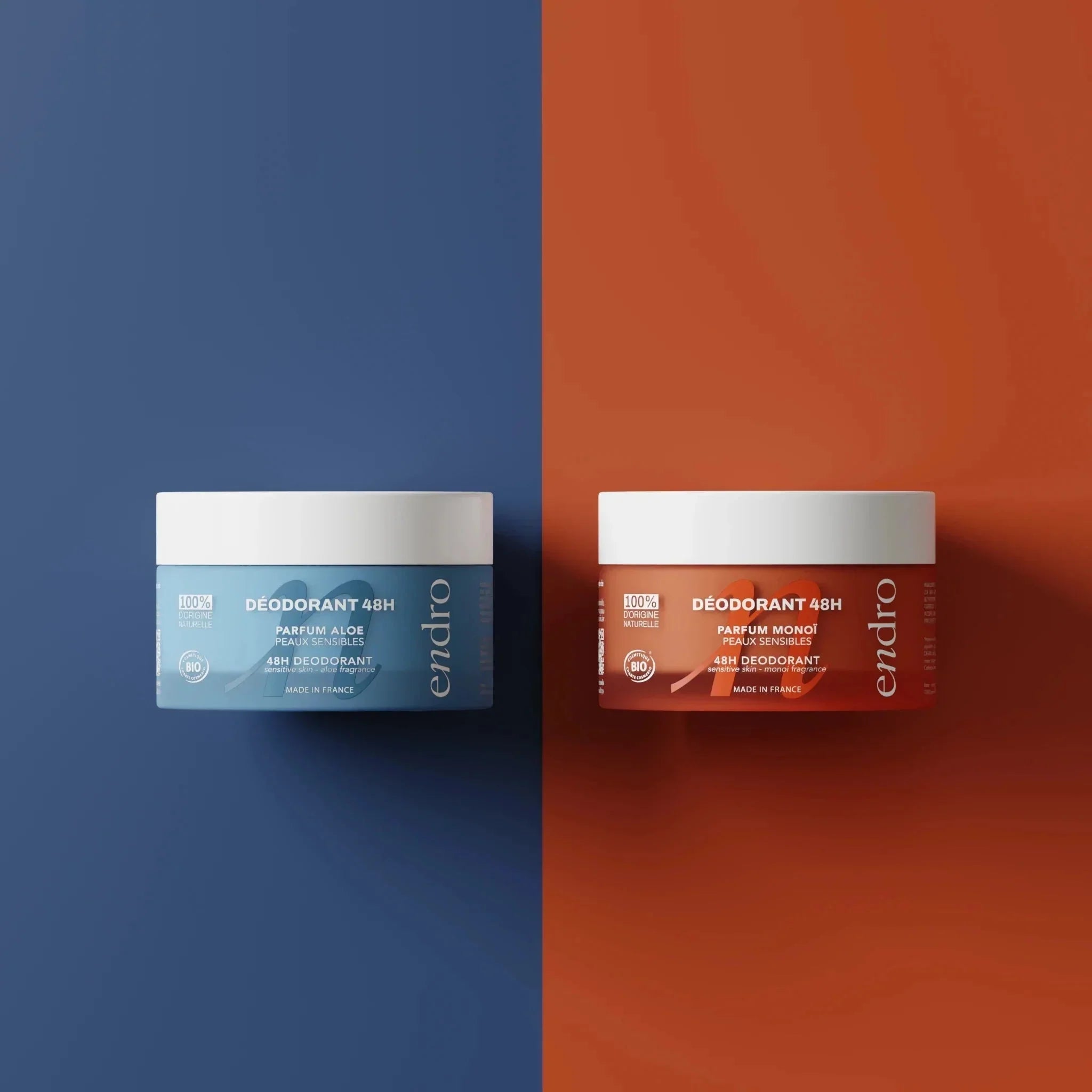
Deodorants can work through two different mechanisms. They either contain antimicrobial agents that help reduce the growth of bacteria responsible for bad odors (like our deodorants Coconut, Palmarosa, Mint and Bergamot), or agents that absorb or mask these odors (like our sensitive skin deodorant).Unlike antiperspirants, they do not prevent the production of sweat and allow the body to eliminate toxins while regulating itself naturally!
Perspiration is a natural phenomenon that allows our body to eliminate toxins. Hence the current controversies regarding antiperspirants that block this elimination.

Leave a comment
This site is protected by hCaptcha and the hCaptcha Privacy Policy and Terms of Service apply.